

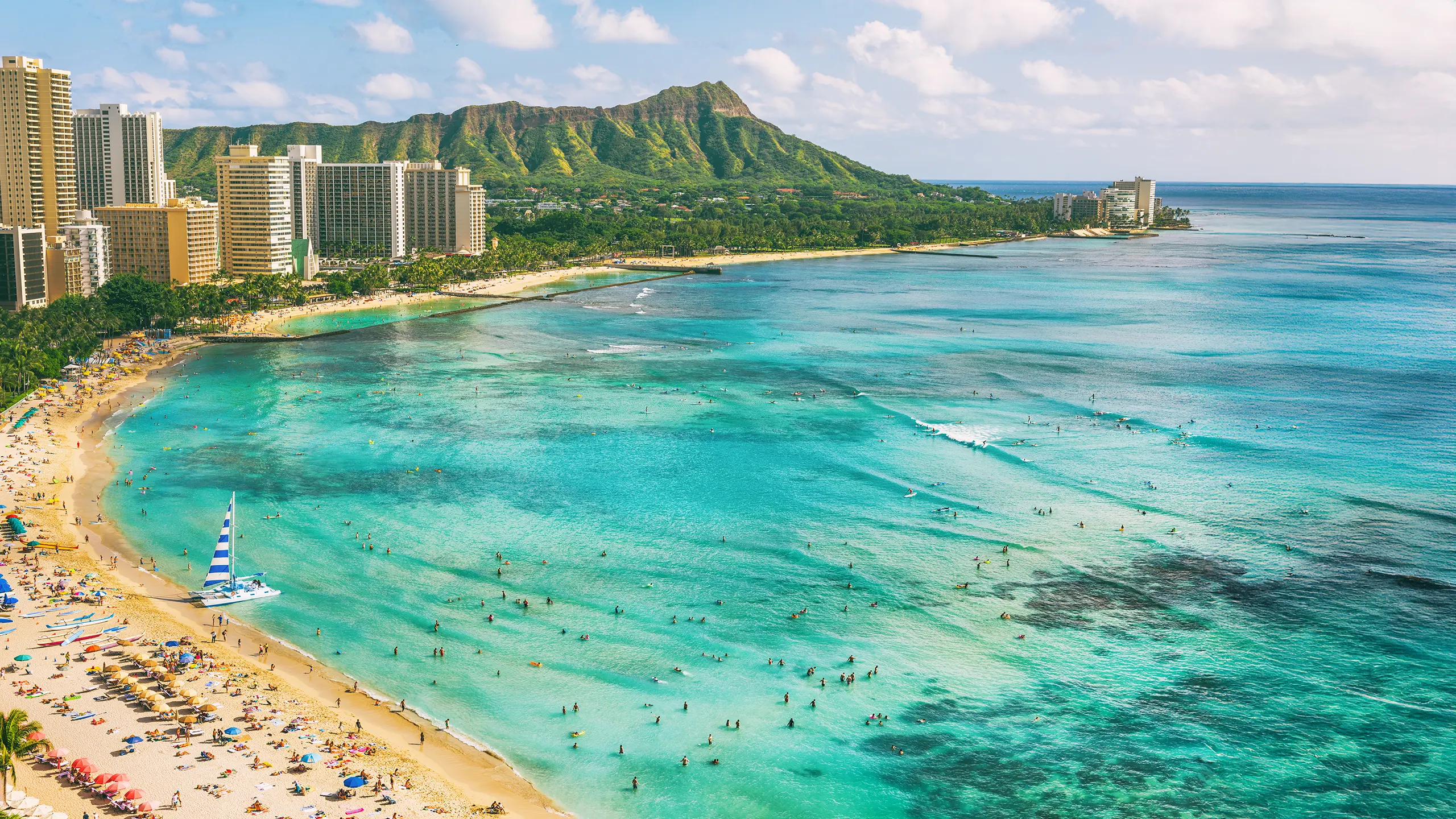
Surf spots in Waikiki. A practical guide for lessons, beginners, and experienced surfers
Waikiki has a lot of named surf breaks, but they are not interchangeable. The best spot depends on what you are trying to do, how far you are willing to travel, and whether you are dealing with reef, deep water, or lineup dynamics. This guide explains the main central Waikiki breaks, why surf lessons cluster where they do, and what is realistic for beginners, intermediates, and advanced surfers visiting the area.
How Waikiki surf schools choose a spot for lessons
Surf schools do not pick a break because it is famous or because it has the best waves. They pick breaks based on proximity to the hotel core, safe and predictable access, space to manage students, and wave behavior that gives beginners repeated chances to stand up. Beach access and amenities matter. The ability to stage boards and meet on sand matters. Inside waves matter, but inside waves are not the same everywhere. A spot can be close to Waikiki and still be a poor choice for instruction if it is shallow reef, pitchy, localized, or logistically awkward.
Central Waikiki surf spots. What each break is really like
- Canoes. The default for first-time lessons and beginners. Central access, forgiving conditions, consistent waves, and a long cultural history of instruction.
- Queens. One of the best performance waves on the south shore, but not a lesson spot. Fast, competitive, and heavily locally enforced.
- Baby Queens. Softer inside zone dominated by local kids and families. Beginner-friendly wave shape, but culturally local-oriented and rarely used by surf schools.
- Publics. Shallow reef, pitchy takeoffs, and high consequence falls. Great wave for skilled surfers, not ideal for first-time instruction, especially at low tide.
- Pops and Paradise. Deeper water, long rides, and less congestion, but far access and swell dependence. Lessons happen here mainly for schools based at the far end of Waikiki.
- Threes and Fours. Smaller peaks farther out and more isolated. Not typically used for lessons due to exposure and logistical friction.
Canoes. The center of Waikiki surfing
Canoes sits at the geographic and cultural center of Waikiki Beach. If someone walks down to Waikiki Beach proper and looks out from the main stretch of sand near the Duke Kahanamoku statue, this is the surf break they are looking at. It is the most direct and familiar expression of Waikiki surfing, and it has immediate access from the highest concentration of hotels, shops, bathrooms, and beach activity.
Canoes works for first-time surfers because it combines walkability, forgiving conditions, and consistent waves. There is a large inside and a broad outside with multiple peaks, which allows many people to surf without funneling into a single takeoff zone. The paddle is manageable. The water is clear and feels approachable. The bottom is relatively forgiving compared to many other reef breaks nearby. On small days, Canoes still produces rideable waves, which is not true everywhere in Waikiki.
Most lessons happen on the inside waves. Depending on conditions, crowding, and student ability, some instructors will take surfers farther out, but the inside provides enough consistency that progress can happen without pushing beginners into more demanding water. Canoes also has long-standing cultural acceptance of instruction. Lessons have happened here for generations, and the lineup expects it.
Canoes is also regulated. Instruction, rentals, and umbrella stands operate under city concessions that are periodically rebid, which limits who can operate there at any given time. This system replaced the older informal Beach Boy era. Today, Canoes is highly controlled, commercially competitive, and extremely valuable, which is one reason the beach looks organized despite constant demand.
Queens and Baby Queens. World-class wave, zero tolerance for instruction
Queens and Baby Queens are located immediately to the left of Canoes when facing the ocean. They are close enough to look similar from the beach, but they behave very differently. These breaks mark a sharp transition from instruction-friendly surf to performance-driven surfing and local community surfing.
Queens is one of the best waves on the south shore. It is fast, powerful, and high-performance, with a tight takeoff zone and limited peak width. On good days, only one or two surfers can realistically take off on a given wave. It is also heavily locally enforced. Even skilled surfers often avoid Queens because lineup control can be intense, especially when the wave is firing. For that reason, instructors treat Queens as a non-starter for lessons. The risk is not only physical. It is also social and operational. Queens demands precision, and the lineup has no tolerance for groups, mistakes, or instruction pacing.
Baby Queens sits inside and adjacent to Queens and behaves differently. It is a softer inside zone where waves reform in a way that allows many surfers to catch waves. On most days it is crowded with local kids and families. It can be beginner-friendly in terms of wave shape, and it is a good place for independent practice, but it is culturally local-oriented rather than surf-school-oriented. There are no concessions and limited tolerance for organized groups.
Publics. Shallow reef, quality waves, narrow margin for instruction
Publics is located to the left of Queens and Baby Queens when facing the ocean. While still part of the central Waikiki reef system, it sits farther from the main beach access points and marks a transition into true shallow reef surfing. Publics is an excellent wave under the right conditions, but it is not forgiving.
Publics is extremely shallow reef. At low tide, reef can be visibly exposed, and falling here almost always means contacting reef rather than sand. The paddle out crosses reef the entire way, which increases the chance of cuts, scrapes, and contact with sea urchins. The wave is also pitchy because shallow reef produces fast, steep takeoffs. That shape rewards confident positioning and early commitment. For beginners, pitchy takeoffs create late drops, and late drops at Publics carry consequences.
Publics has no beach concessions or built-in instructional staging. Schools operating here typically transport boards by vehicle. Used carefully and at the right tide, it can work for stronger students. Used casually, especially at low tide, it raises safety concerns. Publics can be a great wave. It simply requires judgment and restraint when used for instruction.
Pops, Paradise, Threes, and Fours. Deep water breaks with logistical tradeoffs
Pops and Paradise sit to the right of Canoes when facing the ocean. From Waikiki Beach they are visible, but they are far enough away that schools operating from central Waikiki do not walk students down or expect beginners to paddle there. Schools that teach at Pops and Paradise are typically based at the far end of Waikiki, with storefronts and board staging closer to those breaks.
Access defines the experience. Paddling to Pops from Canoes is a long effort even for experienced surfers. As a result, instructors commonly tow students out by pulling them through the channel. The paddle out crosses shallow reef before transitioning into deep water. Once out, the water is significantly deeper than Canoes, and the bottom is not visible. For students uneasy about open water, this can be psychologically intimidating even if the conditions are otherwise calm.
When Pops and Paradise are working, they offer long rides, multiple peaks, and more open spacing than the busiest central breaks. They are often calmer because fewer surfers are willing to make the paddle, and because these breaks do not sit in front of a sandy walk-in beach. From the lineup, the shoreline is largely rock wall, which changes entry and exit logistics and makes the area feel more exposed.
These breaks are also swell dependent. Canoes can provide rideable waves even on small days. Pops generally needs more size and energy to break consistently. Instruction usually stays on the inside zones at Paradise and Pops rather than the main performance peaks, which are often used by locals seeking space away from crowded central reefs.
Threes and Fours sit farther along the same reef line. They are smaller peaks, more isolated, and feel farther off the beaten path. Because of exposure and logistics, they are not common lesson zones. Schools that operate in this area concentrate on the inside sections of Pops and Paradise instead.
Which Waikiki surf spot is best for which type of surfer
In Waikiki, surf spot choice is often determined less by wave quality and more by travel distance, board logistics, time pressure, and local crowd dynamics. The same break can be ideal for one person and a poor choice for another depending on what they are trying to do and how they are accessing the water.
First-time surfers and beginners staying in central Waikiki
For visitors staying in central Waikiki, Canoes is the practical default. It sits directly in front of Waikiki Beach, where most hotels, shops, bathrooms, police presence, rentals, and beach activity already exist. From a learning standpoint, it is also one of the most forgiving breaks in the area. The water is clear and approachable, the paddle is manageable, and the waves are slow, consistent, and available year-round. Instruction is culturally normalized here, which matters as much as wave shape.
Beginners progressing beyond a first session
Canoes continues to work well for progression because it has multiple peaks and enough spacing to move around. On some days, Baby Queens can also be a good place for independent practice, especially for surfers accompanied by family or friends. It is wave-friendly but culturally oriented toward local kids and families rather than organized instruction.
Intermediate surfers seeking better waves while staying in Waikiki
For intermediate surfers, ability matters, but logistics often matter more. If you are willing to walk far and manage a long paddle, Pops and Paradise can be excellent when they are working. The paddle is long but manageable for someone with experience, and the rides can be long and open with less congestion than central breaks.
Other options exist in theory, but distance and board constraints eliminate many of them in practice. Most visiting surfers are on rental boards, often billed by the hour. Long walks reduce water time. Shallow reef increases damage risk and liability. Few tourists are willing to strap boards to cars and drive to more peripheral breaks, especially if they are on the clock.
Because of these constraints, many intermediate surfers end up choosing from a short list: Canoes, Pops, Paradise, and occasionally Publics under the right tide and conditions. Even experienced surfers often default to the outside of Canoes, sitting wider for set waves, because it is easy and convenient even if it is not the most exciting option.
Advanced surfers and performance-focused surfing
Queens is one of the most high-performance waves in Waikiki, but it is also one of the most competitive and locally enforced. Advanced ability does not guarantee a positive experience there. Skill alone does not offset lineup dynamics. Many strong surfers choose to avoid it and surf elsewhere.
Advanced surfers looking for quality rides and space often choose the outer peaks at Pops and Paradise when the swell is right, or the outside of Canoes when they want convenience and predictable access. For most visitors, that combination of access and quality ends up being more realistic than chasing the most famous performance wave in the area.
Why Canoes remains the default for first-time lessons
Despite the range of surf spots in Waikiki, Canoes remains the default for first-time lessons because it solves the most problems at once. It is central to the hotel core. It is easy to access. It is forgiving and consistent. It feels safe and approachable to nervous beginners. It has multiple peaks and space to teach. It is also culturally accepted as a place where instruction has happened for generations. For visitors, Waikiki Beach is where everything is happening. Canoes is the surf break attached to that experience.Canoes. The center of Waikiki surfing